


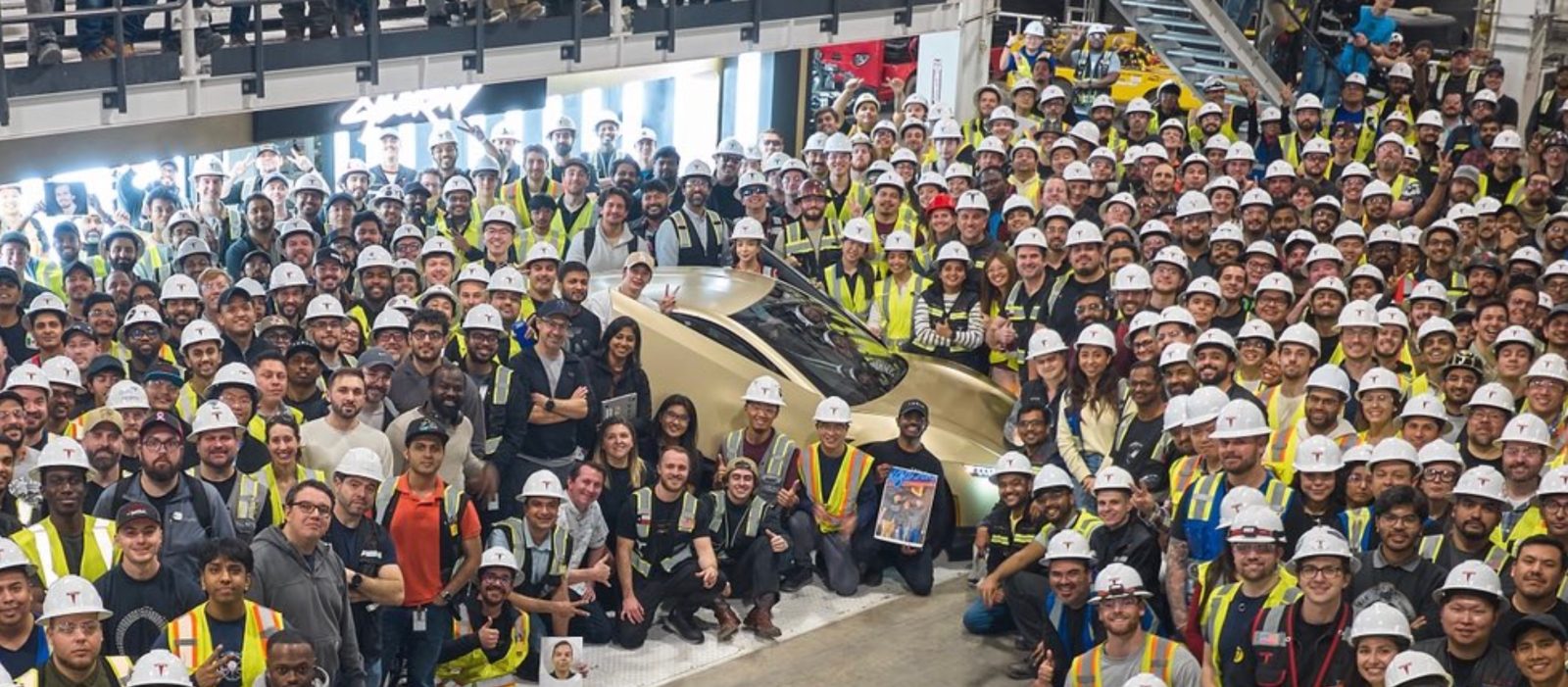
Tesla shared in the present day that the primary Cybercab manufacturing unit has rolled off the meeting line at Gigafactory Texas. The automobile has no steering wheel and no pedals. It’s totally depending on autonomous driving software program that, based mostly on each obtainable knowledge level, Tesla has not solved — and is nowhere near fixing.
Even the title “Cybercab” shouldn’t be set in stone.
The announcement comes on a day after we printed our newest robotaxi standing verify exhibiting that Tesla’s “Robotaxi” program in Austin is crashing at practically 4 occasions the speed of human drivers, operates at simply 19% availability, and has roughly 40 autos on the street eight months after launch.
Tesla introduced in the present day that it produced its first Cybercab off its manufacturing line at Gigafactory Texas:
Whereas that is the primary manufacturing unit, steady manufacturing shouldn’t be anticipated to start out till April.
The info doesn’t assist the product
Tesla’s robotaxi pilot in Austin, which makes use of Mannequin Y autos outfitted with the identical “autonomous driving” expertise as Cybercab, has gathered roughly 14 crashes throughout an estimated 800,000 cumulative miles, understanding to one crash each 57,000 miles. By Tesla’s personal benchmark of 1 crash per 229,000 miles for human drivers, its “Robotaxi” fleet is crashing practically 4 occasions extra typically than the common particular person behind the wheel, and just about each a kind of miles was pushed with a skilled security monitor within the automobile.
The most recent standing verify of Tesla’s robotaxi program paints a fair bleaker image. Over a 48-hour monitoring interval, the Austin service was obtainable simply 19% of working hours. Eight months after launch, Tesla operates in solely two cities, Austin and San Francisco, with roughly 200 autos complete, most of these autos being in San Francisco, with drivers within the driver’s seat, regardless of Musk claiming “nicely over 500” on the This fall 2025 earnings name.
Maybe most damning: Tesla’s supposedly “unsupervised” rides turned out to be something however. Video proof confirmed the autos being carefully adopted by black Tesla trailing vehicles with security displays inside. Tesla didn’t take away the security displays, it simply moved them to a special automobile.
One fanatic took 58 rides over per week earlier than lastly getting a single genuinely unsupervised one. Then, the unsupervised rides vanished totally per week after the pre-earnings announcement.
To today, just a few riders per week report rides with no supervisors or trailing vehicles.
Musk’s personal goalpost: 10 billion miles
In January, Musk himself admitted that Tesla wants roughly 10 billion miles of information to realize “secure unsupervised self-driving.” Primarily based on present fleet development and FSD engagement charges, Tesla is projected to cross that threshold round July 2026. However amassing the info is just the 1st step, Tesla nonetheless wants huge coaching runs, validation testing, and debugging of thousands and thousands of edge instances, which means the software program probably gained’t be prepared for an additional 12 months past that milestone.
Tesla has additionally delayed its next-gen AI5 chip to mid-2027, which means the Cybercab will launch on the current-generation AI4 {hardware}.
And but, the primary manufacturing unit of a automobile that relies upon totally on this unsolved software program simply rolled off the road in the present day.
Tesla has a sample of untimely {hardware} bets based mostly on autonomy
The corporate has a well-documented historical past of eradicating options within the title of a self-driving future that wasn’t prepared, after which quietly strolling these selections again.
In 2021, Tesla eliminated radar from Mannequin 3 and Mannequin Y autos, overruling its personal engineers who warned in opposition to the transfer. The end result was an uptick in crashes, close to misses, and phantom braking incidents. In 2022, Tesla eliminated all ultrasonic sensors from its autos earlier than its camera-based replacements have been prepared, delivery vehicles with out Park Help, Autopark, Summon, or Good Summon for months.
Then there was the yoke steering wheel, launched on the Mannequin S and X in 2021 as a nod to Tesla’s autonomous future, Musk argued that stalks and a spherical wheel weren’t mandatory on a automobile that will quickly drive itself. He refused to supply a spherical different. Two years later, Tesla broke and began providing the spherical wheel once more, ultimately making it the default and charging a $250 premium for the yoke as a substitute. The corporate even supplied a $700 retrofit for house owners caught with the yoke.
The flip sign stalk adopted the identical arc. Tesla deleted the stalk from the Mannequin 3 Highland in 2023, changing it with capacitive buttons on the steering wheel. The choice was so unpopular that driving colleges banned the automobile and it dinged Tesla’s near-perfect security score in Europe. By 2025, Tesla’s head of auto engineering Lars Moravy admitted the corporate had “deleted an excessive amount of.” Tesla introduced the stalk again on the Mannequin Y Juniper refresh and began promoting $595 retrofit kits to repair the issue it created, actually charging clients lots of of {dollars} for an element it by no means ought to have eliminated.
Each one among these reversals concerned Tesla making a {hardware} guess on an autonomous future that wasn’t prepared. With the Cybercab, Tesla is making essentially the most excessive model of this guess but — and this time, there’s no retrofit that may repair it.
Electrek’s Take
The Cybercab is a two-passenger automobile with butterfly doorways, no steering wheel, and no pedals. It has a 35 kWh battery with 200 miles of vary and inductive charging. Musk has described its manufacturing course of as nearer to client electronics than automobile manufacturing, with a goal cycle time of 1 unit each 10 seconds.
The automobile is designed to price beneath $30,000 and function completely as an autonomous taxi. There isn’t a fallback. If the software program doesn’t work, the automobile actually can’t be pushed.
Tesla’s personal chairwoman, Robyn Denholm, signaled that the Cybercab may want a steering wheel in any case, however Musk shortly shut that down. Cybercab prototypes have been noticed testing with steering wheels in Austin late final 12 months. Tesla has additionally but to safe the “Cybercab” trademark, the corporate simply acquired a 30-day extension to oppose a squatter’s declare, pushing the deadline to March 14, lower than a month earlier than the said manufacturing date.
This is without doubt one of the most reckless product selections in automotive historical past. Tesla is now not speaking about constructing a automobile that can’t operate until software program that doesn’t exist but is perfected — it’s truly doing it. The primary Cybercab simply rolled off the road. It has no steering wheel. It has no pedals. If FSD isn’t solved, this automobile is a $30,000 paperweight on wheels.
We’ve been overlaying Tesla’s self-driving guarantees for practically a decade. Musk promised a cross-country autonomous drive in 2017. He promised a million robotaxis on the street by 2020. He promised “Full Self-Driving” can be solved “subsequent 12 months” just about yearly since. And now, along with his personal admission that Tesla wants 10 billion miles of information, with a crash charge 4 occasions worse than human drivers, with “unsupervised” rides that required trailing security vehicles, he’s greenlighting manufacturing of a automobile that bets every thing on the expertise being prepared.
We’ve additionally watched this firm take away radar, take away ultrasonic sensors, take away flip sign stalks, and pressure a yoke steering wheel on clients, all within the title of an autonomous future that wasn’t and isn’t prepared. Most of these selections have been ultimately reversed, generally on the buyer’s expense. The Cybercab is the last word model of this sample: a automobile designed totally round solved autonomy, produced earlier than autonomy is solved. The distinction is that when Tesla eliminated a flip sign stalk too early, it might promote a $595 retrofit. When it builds hundreds of autos with no steering wheel and the software program doesn’t work, there isn’t a retrofit.


FTC: We use revenue incomes auto affiliate hyperlinks. Extra.

