


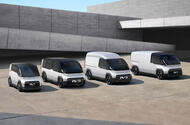
Kia’s Platform Past Car vary of electrical vans is about to shake up the worldwide marketplace for business autos
On this transition period for the automotive business, barely per week passes with no producer wheeling out a daring new electrical machine with a flashy presentation that claims it brings tomorrow’s expertise to at this time’s roads and can remodel the fortunes of the agency that made it.
However these displays do not usually embody prolonged sections on load-bed entry, Euro-pallet capability and bumper repairability.
Besides they do when your transformative imaginative and prescient of future motoring is a van-although that maybe undersells the importance of the new Kia PV5. The agency labels it a Platform Past Car (PBV), and it is the primary in a spread of extremely customisable bespoke electrical fashions supposed to disrupt the business automobile market and assist proceed Kia’s outstanding development.
Consider the impression of the model’s bespoke EV line-up, however for vans. This is not strictly Kia’s first foray into business autos: the Bongo cab-over pick-up has been bought in Korea and different markets since 1981 and spawned the Pregio van and MPV.
However that is a completely contemporary enterprise mannequin, and one designed for quantity: Kia is aiming to achieve gross sales of 250,000 PBVs yearly by 2030. “That is the subsequent chapter of the Kia story,” says Sangdae Kim, head of the agency’s PBV division. “That is how we transfer ahead as a number one EV model.”
Kim – often known as SD, which he quips stands for “Good System, similar to our PBVs” – has been constructing the brand new division for round 4 years. He says Kia recognized the business automobile market as one with “room for significant innovation” via the event of a line of electrical vans, including: “Our PBVs are designed to adapt to folks, not drive folks to adapt to it.”
The electrical van market is small however rising quick, notably as a result of many companies are being pushed to change to zero-emission fashions for their very own environmental targets. However most electrical vans in the marketplace are both conversions of combustion vans (suppose the Ford E-Transit or the various Stellantis fashions), whereas the Volkswagen ID Buzz makes use of a frivolously modified model of the VW Group’s MEB platform.
For its PBVs Kia has developed a specifically tailor-made model of the Hyundai Motor Group’s bespoke EV platform, named E-GMP.S (Electrical International Modular Platform for Service), which the agency says offers rather more flexibility to create a spread of modular and customisable machines. It is a front-driven platform, and the PV5 options a wide range of battery sizes – giving a spread of as much as 258 miles and 4.4 cubic metres of load capability.
The 4.7-metre-long PV5 is the primary of these, with Kim describing it as “our manner into the LCV market”. It will likely be adopted by the PV7, which might be round 5.2 metres, based mostly on a idea automobile, and the PV9. These two will arrive in 2027 and 2029 respectively.
Given how rapidly Kia is filling out its EV line-up with a full vary of numbered fashions, you’ll be able to take a guess at how large the secure might ultimately develop into. A small PV1 Idea has been proven, however smaller autos aren’t an early precedence.
However every of the PBV line-up is excess of only a singular automobile: the modular design permits for large flexibility. The PV5 might be launched with Cargo and Passenger variants, however the vary will ultimately permit for seven bodytypes with 16 specs.
So the Cargo can have three- and four-door variations, a larger-capacity Excessive Roof possibility and crew and chassis cab variants. The Passenger will acquire six- and seven-seat variations – it is going to be launched as a five-seater – together with a Wheelchair Accessible Car variant.
Kim says Kia carried out in depth analysis with potential clients in varied fields – from supply corporations to ride-hailing companies – to assist develop the small print of the PV5. For instance, the bumpers are made in three components, making it cheaper to switch a bit whether it is broken, whereas the step peak of the van has been saved as little as potential for supply corporations.
The dynamics of the PV5 have additionally been refined for its use state of affairs. In Cargo type it is direct and straightforward to deal with, with nice visibility from the high-up driving place. It is not massively dynamic, however the car-based roots of the platform will be felt in additional refined dealing with than many vans.
Inside, all the pieces is constructed for function. It is not as properly appointed because the Passenger model, however the supplies are all hard-wearing to deal with prolonged use and there is a great deal of sensible storage. That target usability and practicality is baked into each aspect.
The PV5 might be manufactured at Kia’s Autoland Hwaseong plant, positioned within the sprawling southern suburbs of Seoul. The three.2 million-square-metre facility is Kia’s largest manufacturing website, with round 520,000 autos produced there annually, together with the Sorento, Niro, EV6 and K8 saloon.
Greater than £560 million has been invested in establishing a brand new 100,000-square-metre facility to construct the PV5, creating round 1000 jobs thus far. When full mass manufacturing begins, the plant can have capability of round 100,000 PV5s per 12 months (together with about 70,000 Tasman pick-ups), with two eight-hour shifts per day producing a automobile each 4 minutes or so. A second new manufacturing facility is already below building at Hwaseong to fabricate the PV7 and PV9.
Autocar’s go to comes on a vacation on the manufacturing facility, however the potential is evident as we wander alongside the huge manufacturing line. The method is extremely automated, partially due to the necessity for the heavy flexibility required to provide such a variety of variants on a single line.
However the distinctive facet – and maybe the true magic-of this plant is positioned on the finish of the manufacturing line, the place a lot of devoted bays are ready to just accept newly constructed PV5s for in depth customisation.
That is the important thing to the enterprise mannequin dreamed up by Kia president Ho Sung Track, and it is vital to the PBV operation by providing larger cost-effectiveness and being much less wasteful. “With business autos, so lots of them have a customisation course of, which is often finished by exterior companions,” Track tells Autocar.
Many business autos go straight from a manufacturing line to a third-party agency for conversion to fulfill the necessities of the corporate that is shopping for them. That, says Track, is just not good commercially, and it isn’t good for the setting as a result of folks produce a brand new automobile solely to instantly throw out the production-line inside. It is wasteful.
“By producing as many variants contained in the manufacturing facility as potential we are able to make that course of simpler, and we are able to produce the autos to fulfill the order from the beginning, with minimal waste,” says Track.
Meaning components reminiscent of refrigerated models, bespoke shelving and storage will be added within the manufacturing facility at supply. Kia will nonetheless work with companions the place acceptable: for instance, it’s planning light- and full-camper kinds, with conversions finished within the manufacturing facility and thru camper specialist Westfalia. Even then, Kia will provide autos to third-party corporations with solely the weather wanted, so nothing must be eliminated.
The opposite enterprise facet of the PBV aspect is software program and fleet administration: Kia has developed a bespoke working system, which permits the cloud-based companies and fleet administration choices that business automobile clients require.
Europe, together with the UK, and Canada might be key goal markets at launch, however these are totally international merchandise. Notably, Kia will promote the PV5 in Japan-the first time it has provided a automobile available in the market.
That is partly for historic causes you do not see many Japanese vehicles in Korea, both – however Kim says the agency recognized an enormous alternative given the expansion potential of the electrical LCV market there.
And it is that development potential that underpins this complete enterprise. “It may be very difficult,” says Track of the prospect of hitting Kia’s formidable PBV targets. “However we’ve a robust plan, and that is the correct determination.”

